
Spinsy KYC Verification: Documents, Timing & Withdrawals
 Available in AU
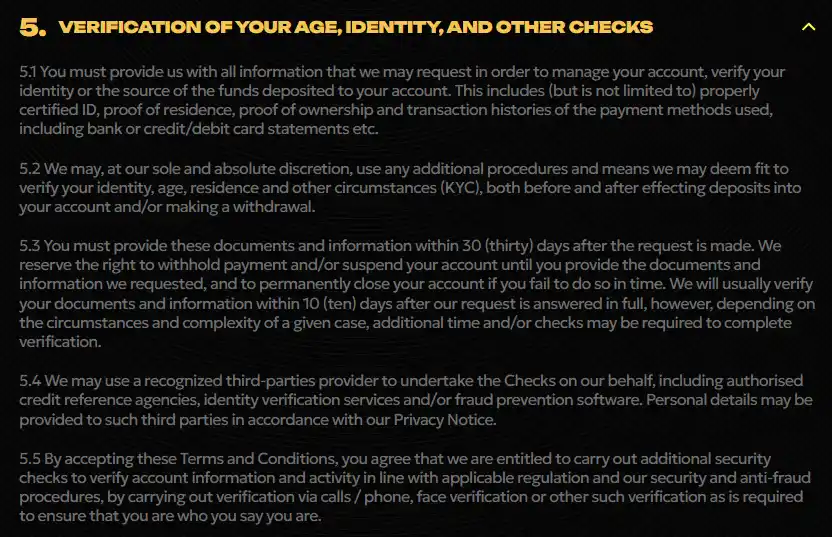
Spinsy can require customers to verify identity, age, residence and source of funds. The current General Terms list properly certified identification, proof of residence, and evidence of payment-method ownership and transaction history, including bank or card statements, among the material that can be requested. The same terms say documents and information are usually verified within 10 days after a verification request has been answered in full, while allowing extra time or additional checks when a case is more complex.
KYC is directly connected to payments rather than being a one-off registration formality. Spinsy’s terms allow checks before or after deposits and in connection with withdrawals, and they allow a withdrawal to be delayed until required verification is completed. The 10-day wording is therefore a document-review timeframe, not a guaranteed payout time and not a promise that every account will take 10 days to verify.
Table of Contents
- Official references
- What Spinsy currently says it can verify
- How the KYC sequence can unfold
- What the 10-day verification wording actually means
- Payment-method ownership is one of the most important KYC links
- How to prepare for a Spinsy verification request without guessing requirements
- KYC does not establish Australian regulatory status or consumer protection
- Common Spinsy KYC questions
- What verification can affect
Official references
- Spinsy General Terms and Conditions
- Spinsy Privacy Notice
- Spinsy AU-facing site
What Spinsy currently says it can verify
The official terms give Spinsy broad verification scope. They say the operator can request information needed to manage an account, verify identity, or establish the source of deposited funds. They also say checks can cover identity, age, residence and other circumstances. For a reader trying to understand a pending account review, that means KYC can involve more than matching a name to a single document.
| Verification area | What the current terms support | Why it can matter |
|---|---|---|
| Identity | Properly certified ID can be requested. | Supports identity and age checks. |
| Residence | Proof of residence can be requested. | Supports residence and jurisdiction checks. |
| Payment ownership | Evidence that the payment method belongs to the customer can be requested. | Connects the account holder to the funding or withdrawal route. |
| Transaction history | Bank or credit/debit card statements and transaction histories are named as examples. | Can support payment and source-of-funds review. |
| Source of funds | The terms allow information requests about the source of deposited funds. | Can become relevant to financial checks before a payout is approved. |
The table deliberately stays at category level. It does not convert the terms into a universal checklist such as “everyone must upload a passport plus one utility bill” because that is not what the source says. The terms describe material that may be requested, so the exact combination can depend on the account and the check being performed.
How the KYC sequence can unfold
Spinsy’s current terms allow identity and related checks both before and after deposits and when a withdrawal is being made. That makes the practical sequence conditional rather than fixed. One account might be asked for verification before a financial action proceeds, while another might encounter an additional request later when a withdrawal or source-of-funds review is triggered.
- A verification request is issued: the account is asked for specific information or documents relevant to the check.
- The customer provides the requested material: the terms’ usual verification clock is tied to the request being answered in full, not simply to the first file being uploaded.
- The operator reviews the response: further checks can be required if the circumstances or complexity justify them.
- The account or payment process continues: a withdrawal can remain delayed while required identity, source-of-funds or compliance checks are still open.
KYC can occur at several stages rather than only before withdrawal. The dedicated Spinsy registration page covers the surrounding account lifecycle, while the details below concern the verification process itself.
What the 10-day verification wording actually means
The current General Terms say Spinsy will usually verify documents and information within 10 days after its request has been answered in full. They immediately qualify that wording by saying extra time and additional checks can be required depending on the circumstances and complexity of a case.
Three details matter when interpreting that statement. First, “usually” describes the operator’s normal document-review expectation, not a hard maximum. Second, the period starts from a full response to the request rather than from registration, deposit or withdrawal submission. Third, verification time and withdrawal processing are separate clocks. Completing KYC does not by itself guarantee a payout on a particular date.
Payment-method ownership is one of the most important KYC links
The terms connect verification to the payment route in two ways. They require customers to use payment methods that belong to them, and the KYC section allows proof of ownership and transaction histories to be requested. That makes payment ownership a practical bridge between account identity and withdrawal review.
For example, a bank or card statement can serve a different purpose from an identity document. The ID establishes who the account holder is, while payment evidence can help establish that the financial instrument and transactions belong to that person. The current terms do not state a universal statement period, card-image requirement or file format for every case.
This distinction also explains why a clean identity check does not automatically settle every banking question. The broader withdrawal guide covers the operator’s payout rules, while KYC evidence can become a precondition for moving a request forward.
How to prepare for a Spinsy verification request without guessing requirements
The most reliable approach is to follow the request shown in the account or sent by the operator and provide exactly the categories it asks for. The current terms support the broad categories above, but they do not justify a permanent article claiming that every Australian user will receive the same list in the same order.
- Match the account identity: use documents belonging to the person whose account is being verified.
- Read the current request: distinguish identity, residence, source-of-funds and payment-ownership evidence instead of assuming one document covers every category.
- Answer the request completely: the published usual review timing is tied to the request being answered in full.
- Keep payment evidence consistent: payment-method ownership is explicitly part of the current terms, so mismatched ownership can create additional review.
- Use official support routes for clarification: Spinsy states that live chat and email support are available 24/7.
These preparation points do not replace a live document request. If Spinsy changes its verification terms, the current request and current terms take precedence.
When a request is unclear, it is sensible to clarify the requirement through the operator’s published support routes before sending unrelated files. Spinsy states that live chat and email support are available 24/7. That does not guarantee an immediate KYC decision, but it gives the account holder a current route for questions about what the request is asking for, whether a submitted item was received, or whether further evidence is needed. The public terms do not state a fixed escalation ladder, and support is not presented as able to override a compliance review.
KYC does not establish Australian regulatory status or consumer protection
Identity verification is an operator process. It should not be read as evidence of Australian regulatory authorisation or consumer-protection coverage. KYC can exist under many different regulatory models, so the presence of document checks says nothing by itself about Australian regulatory status.
Readers who need the legal and regulatory position should use the separate ACMA and licence status page rather than infer it from verification procedures. Regulatory status is separate from KYC procedures; Spinsy’s current terms describe customer checks and how those checks can affect account and withdrawal processing.
Common Spinsy KYC questions
Which documents can Spinsy request?
The current terms list properly certified ID, proof of residence, and evidence of payment-method ownership and transaction history, including bank or card statements, among the material that can be requested. The exact combination is not presented as identical for every account.
How long does Spinsy verification take?
The current terms say documents and information are usually verified within 10 days after the verification request is answered in full. They also say additional time or checks can be required depending on the case.
Can KYC delay a withdrawal?
Yes. The terms allow withdrawal processing to be delayed while identity, source-of-funds and other required checks are completed. That does not mean every withdrawal is delayed or that KYC guarantees a particular payout result.
Is KYC only done at registration?
No fixed registration-only sequence is supported. The current terms allow checks before and after deposits and in connection with withdrawals.
What verification can affect
Spinsy’s current terms state that the operator can verify identity, age, residence and source of funds; it can request certified ID, residence evidence and payment-ownership or transaction material; and it says a full response is usually reviewed within 10 days, with extra checks or time possible. Verification can occur around deposits and withdrawals rather than only when an account is first opened.
The practical point is to treat KYC as a conditional account and payout dependency, not as a guaranteed one-step checklist. For the broader product context, return to the Spinsy Australia review.
Recommend

Spinsy Games & Pokies in Australia
Spinsy's AU-facing casino catalogue is broad and is organised around pokies, table games, live casino...
Is Spinsy Legit in Australia? ACMA, Licence & Consumer Protection
Spinsy does not appear in the current ACMA licensed-provider register. The Australian Communications and Media...
Spinsy Payment Methods & AUD Banking
Spinsy's AU-facing site publicly displays Visa, Mastercard and Interac payment branding, and cryptocurrency payment support...

Spinsy Mobile Casino: Browser Access & App Status
Spinsy can be used through a mobile browser on a smartphone. The current AU-facing site...

Spinsy Bonuses & Promotions for Australia
Spinsy publishes casino promotions on its Australia-facing English site, but the useful way to assess...

Spinsy Registration & Account Guide for Australia
Spinsy maintains an English-language AU-localised site whose current public navigation shows both "Log in" and...