
Spinsy Payment Methods & AUD Banking
 Available in AU
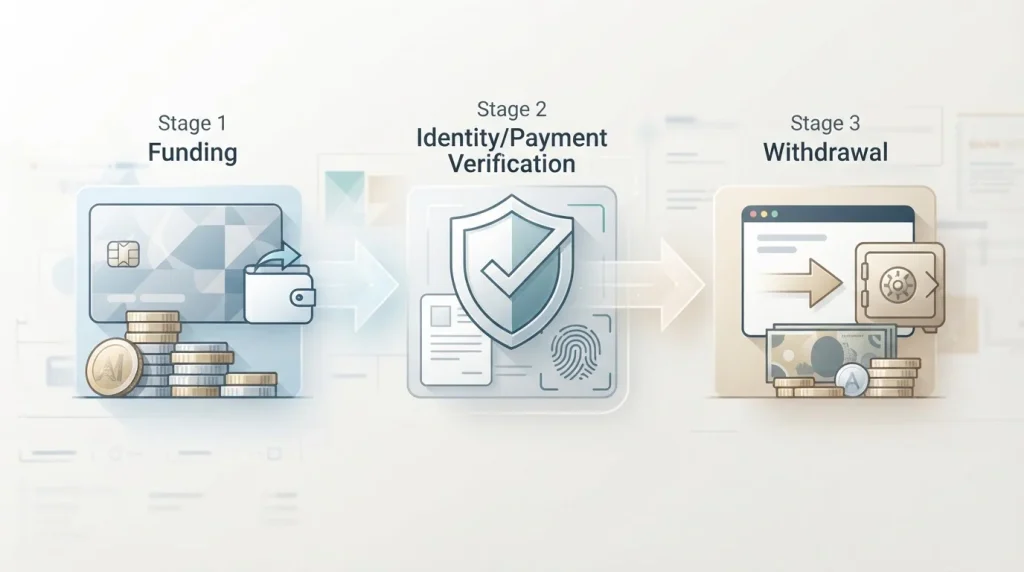
Spinsy’s AU-facing site publicly displays Visa, Mastercard and Interac payment branding, and cryptocurrency payment support is supported by two independent sources. Beyond those points, account-level availability requires a current cashier check. Popular Australian options such as PayID, BPAY, Apple Pay and Google Pay should not be attributed to Spinsy without a current cashier-level check, even though some of those methods are widely used in Australia.
The distinction is important. A payment method can be common in the Australian market without being available for a particular Spinsy account. Public payment branding does not guarantee availability for every account, so a current cashier check is still needed for account-specific use. Detailed payout limits and processing belong on the separate Spinsy withdrawals page.
Table of Contents
- Which payment methods are currently associated with Spinsy?
- Why Australian payment popularity is not Spinsy support
- How the deposit flow should be understood
- AUD context and currency display
- Deposits, bonuses and payment-method restrictions
- KYC can interrupt the banking flow
- Deposits and withdrawals should not be collapsed into one list
- What to check in the cashier before using a method
- Australian regulatory context
- How to read the AU payment picture
Which payment methods are currently associated with Spinsy?
The AU-facing Spinsy site displays three payment brands in its public footer: Visa, Mastercard and Interac. Those brands are visible in the public footer, but display alone does not guarantee that every method is available to every account. Account-specific availability still depends on what appears in the individual user’s cashier.
Two independent sources also support cryptocurrency payment availability as a category. Exact coin availability can change, so no permanent coin list is assumed. Exact cryptocurrency availability can change and should be checked in the current account cashier before a specific asset is treated as supported.
| Payment item | Current public indication | What still needs an account check |
|---|---|---|
| Visa | Branding is displayed on the AU-facing site. | Whether it is enabled for the specific account and transaction. |
| Mastercard | Branding is displayed on the AU-facing site. | Current deposit or withdrawal eligibility for the account. |
| Interac | Branding is displayed on the AU-facing site. | Whether it is actually offered in the user’s cashier. |
| Cryptocurrency | Cryptocurrency payments are supported as a category. | The exact coin list and account-level availability. |
| PayID, BPAY and mobile wallets | No current Spinsy support claim is made for these methods. | A current cashier check is required before attribution. |
Why Australian payment popularity is not Spinsy support
The Reserve Bank of Australia’s 2025 Consumer Payments Survey shows why readers may expect familiar local rails. Cards accounted for around 73% of consumer payments in 2025, and debit cards represented about one in every two consumer payments. Mobile-wallet adoption also increased, with 43% of consumers using a mobile device for a contactless payment during the survey diary week, up from 35% in 2022.
PayID is another strong example. Around 50% of respondents reported using PayID during the prior year in 2025, compared with 32% in 2022. That makes PayID an important part of the Australian payment landscape, but it does not make PayID a confirmed Spinsy cashier option. Market adoption and merchant support are two different facts.
Australian payment popularity does not prove Spinsy support. Local market data explains what Australian users are accustomed to, while Spinsy-specific availability depends on what Spinsy actually presents. A reader can therefore use the market figures as an expectation benchmark, not as a substitute for checking the brand cashier. That is particularly important for PayID and mobile wallets because high consumer adoption can make unsupported merchant-level assumptions feel plausible.
How the deposit flow should be understood
The public AU evidence does not expose a complete account-level cashier inventory. The strongest public signal is the Visa, Mastercard and Interac branding shown on the AU-facing site, while display alone does not guarantee availability for every account. Account-specific availability is determined in the current cashier rather than by a generic payment list.
A sensible deposit check starts inside the account rather than from a generic payment list. The user should confirm the payment method shown, the currency displayed, any minimum or maximum amount shown by the cashier, and the terms attached to the transaction before treating that method as currently available. No universal deposit minimums, deposit fees or “instant” processing claims are established by the public information.
That restraint is especially important for card branding. Seeing Visa or Mastercard in a public footer establishes that the brand presents those payment networks, but a card can still be unavailable for a particular transaction because of issuer rules, geography, account status or payment-processor conditions. Public branding is evidence of association, not a guarantee of approval.
AUD context and currency display
Spinsy maintains an AU-localised English site, making AUD the relevant local reference currency. That localisation does not establish every payment provider or conversion route offered inside an individual account.
For banking decisions, the number that matters is the currency actually shown by the cashier before the transaction is confirmed. A payment provider can apply its own conversion rules when the funding source and account currency differ. No universal Spinsy foreign-exchange fee or conversion rate is established.
The same rule applies to cryptocurrency. Crypto support does not mean every balance, bonus or withdrawal is denominated in a particular token. Crypto support is a category-level fact; the exact asset list, network choices and conversion mechanics remain variable. A general crypto label does not establish specific coins, chains, settlement speeds or fees.
Deposits, bonuses and payment-method restrictions
Payment choice can affect promotional eligibility, so banking and bonus analysis should not be treated as completely separate. Spinsy’s general terms state that some promotions require an associated deposit and have their own additional conditions. The current Spinsy bonuses guide therefore focuses on promotion-specific rules rather than assuming that any deposit automatically qualifies for an offer.
From a banking perspective, the important sequence is to check the promotion terms first, then check the cashier method actually available to the account, and only then compare the qualifying amount or other conditions. This avoids the mistake of choosing a payment rail because it is convenient and discovering afterwards that a promotion treats it differently.
Visa, Mastercard, Interac and cryptocurrency deposits are not established as universally eligible for every Spinsy bonus. Their presence as payment categories or brands does not establish universal bonus eligibility. Where a promotion has method-specific exclusions, the promotion’s own current terms are the correct source.
KYC can interrupt the banking flow
Spinsy’s official terms allow identity, age, residence and source-of-funds checks, including checks before or after deposits and before withdrawals. That makes verification part of the payment process rather than a completely separate account topic. A deposit being accepted does not guarantee that a later withdrawal will proceed without verification.
Payment-method ownership can become part of account verification because Spinsy’s KYC terms include source-of-funds checks. Current document categories and timing are covered in the dedicated Spinsy KYC guide.
For banking planning, the simple rule is enough: expect that verification can occur around deposits or withdrawals and be prepared for a source-of-funds check where the account review requires one. That describes the published process without suggesting that every account will receive the same request at the same time.
Deposits and withdrawals should not be collapsed into one list
Deposit and withdrawal methods are not automatically identical. A public payment logo does not establish the exact payout route, processing time, limit or fee. Those banking details should be checked separately rather than inferred from a deposit-facing brand list.
Detailed payout conditions are covered under withdrawal limits and processing, including pending-request rules, timing and withdrawal limits. Payment-method availability and withdrawal conditions should be treated as separate questions.
For a reader, this means the deposit question and the payout question should be checked separately. A method visible at deposit does not automatically establish the exact withdrawal route, processing time, limit or fee. Those details should be checked separately in the current cashier and terms.
What to check in the cashier before using a method
A current cashier check can answer the questions that public pages cannot settle. The useful checklist is practical rather than promotional:
- Method availability: is the payment rail actually shown for the account now?
- Transaction direction: is it available for deposits, withdrawals or both?
- Currency: what currency is displayed before confirmation?
- Limits: what minimum or maximum does the cashier show for that transaction?
- Fees: does Spinsy or the payment provider show a charge before confirmation?
- Bonus interaction: does the selected promotion exclude or restrict the method?
- Verification: is an account or payment-method ownership check required?
Checking the live cashier is more reliable than copying a long generic list of Australian payment brands. Visa, Mastercard and Interac are the payment brands publicly displayed on the AU-facing Spinsy site, while the current account interface decides what can actually be used.
Australian regulatory context
Payment localisation does not establish Australian regulatory approval. The Interactive Gambling Act 2001 prohibits providers from offering online casino-style services to people in Australia. Payment evidence and Australian regulatory status are separate questions.
The full regulatory position is covered in the Spinsy legitimacy in Australia guide. A payment logo, AUD reference or AU-facing site should never be used as proof that the service has Australian regulatory authorisation.
How to read the AU payment picture
The current Spinsy payment picture for Australian readers is narrower than many generic casino banking lists. The AU-facing site displays Visa, Mastercard and Interac branding, while cryptocurrency support is separately reported as a payment category. Those facts do not justify claiming that every displayed brand works for every account or that a specific cryptocurrency is always available.
Australian market data explains why readers may expect cards, mobile wallets and PayID, but popularity is not brand support. PayID, BPAY, Apple Pay, Google Pay and other local methods should not be attributed to Spinsy unless they appear in the current cashier. For the broader brand picture, return to the Spinsy Australia review.