Mines uses concealed selections rather than reel spins, while access, bonus conditions and cashout checks raise separate practical questions.
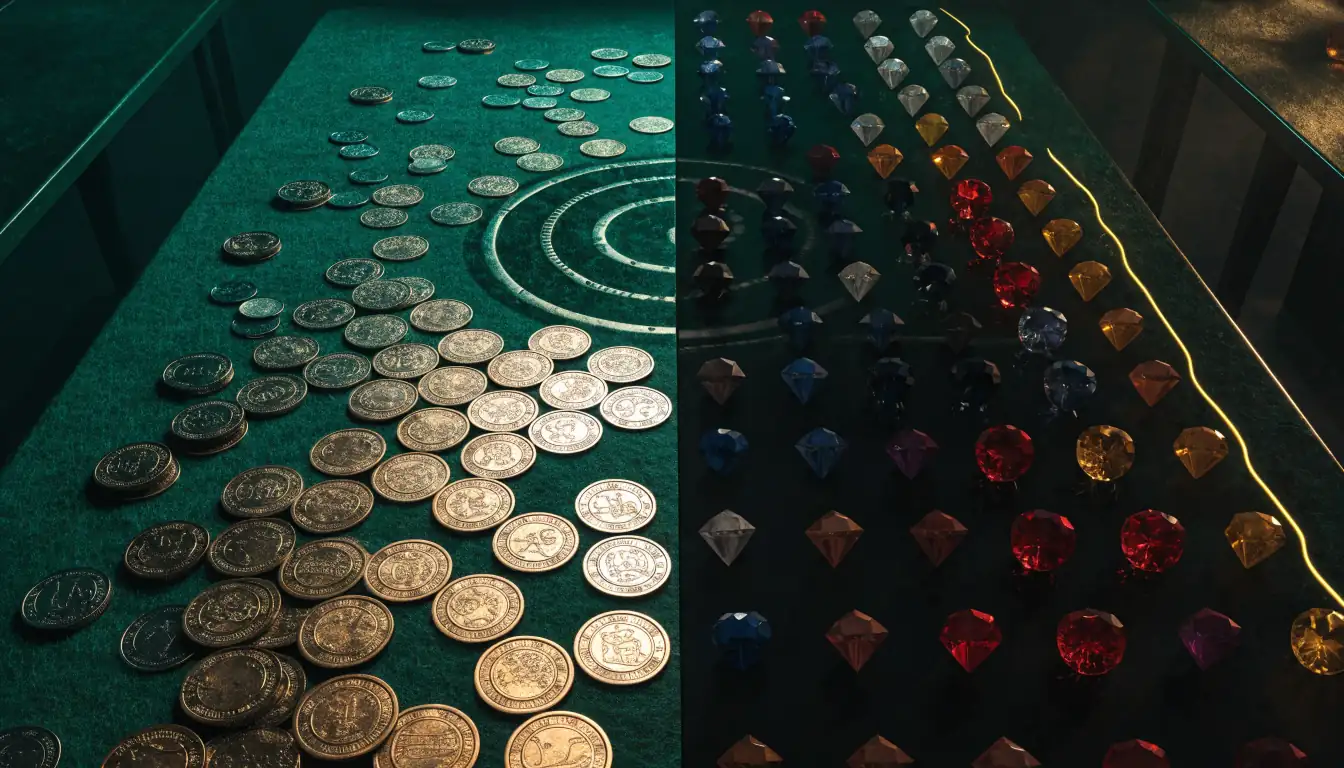
Mines sits in a different corner of the casino-game vocabulary from the pokies many Australians recognise. Big Red, Lightning Link and Queen of the Nile are familiar titles built around the reel-and-symbol format. Mines, by contrast, is generally understood as a choice-based game: you make selections on a concealed layout, with the risk tied to what those selections reveal. The comparison helps explain the broad difference in play, but it does not make the games interchangeable.
That distinction matters when you see Mines grouped alongside pokies in a casino catalogue. A shared menu does not mean a shared design. A reel game presents its symbols through spins; a Mines-style game puts more emphasis on selecting and revealing. You are not comparing the same kind of action simply because both appear under a casino heading.
Nor does the word “slot” settle the question. People may use “slot” loosely to mean any casino game offered on a gambling site, while a pokie in the familiar Australian sense is a reel-based game. So a search for a Mines slot can lead to a category label that is broader than the actual gameplay. Look at the rules and interface description, not just the heading.
When choosing a casino for Mines in Australia in 2026, you should check the available operator information before deciding where to play. This overview gives you a concise reference point for that check.
Golden Pokies
Golden Pokies is listed with a Curacao license, giving you a licensing detail to consider.
Kingmaker
Kingmaker lists a minimum deposit of A$30. Its stated payout speed is around 90 minutes for crypto and 1–5 days for fiat.
SpinsUp
SpinsUp lists a Curacao Gaming Control Board license, OGL/2023/174/0082, held by Dama N.V.
Playfina Casino
Playfina Casino lists a Curacao eGaming license held by Hollycorn N.V., dating from 2017. Its minimum deposit is A$20–30, depending on the offer.
SkyCrown
SkyCrown lists a Tobique Gaming Commission license and a minimum deposit of A$30. Stated payout speeds are around 10–15 minutes for crypto and 1–5 days for fiat.
Uptown Pokies
Uptown Pokies lists a Curacao license and has been operating since 2017. Its stated minimum deposit is A$20.
LuckyVibe
LuckyVibe lists a Curacao Gaming Control Board license, OGL/2023/176/0095, held by Hollycorn N.V.
WinSpirit Casino
WinSpirit Casino lists a Curacao eGaming license, OGL/2024/923/0383, held by Antillephone N.V. Its stated minimum deposit is A$30.
Thor Casino
Thor Casino lists a Curacao license associated with Antillephone N.V. and Versus Odds B.V. Its stated minimum deposit is EUR 20.
Roby Casino
Roby Casino lists a Curacao eGaming license held by Roby Games Ltd.
Comparing Mines with Big Red, Lightning Link or Queen of the Nile can help you place it in context. Those names point to recognisable pokie titles; Mines belongs to a different style of game. If you already know how reel-based play is presented, the contrast is straightforward: Mines centres on choices made within a concealed layout rather than on watching reels resolve.
The comparison can also alert you to what not to assume. Similar placement in a lobby does not establish that games share a provider, payout profile, volatility, bonus features or rules. A title’s popularity or familiarity says nothing reliable about another game’s mechanics. And calling Mines a “slot” in a listing does not turn it into a conventional pokie.
That is where a Mines review should be useful: it should describe the game’s actual rules, explain what a player’s choices do, and identify the information that is specific to that version. A broad label or a comparison with a known pokie is not a substitute for those details. If the description gives no clear account of how the game works, there is little value in filling the gaps with assumptions.
Return to player, or RTP, is another point where comparisons can mislead. KA Gaming slot RTP figures typically range from 94% to 96%. That range describes figures associated with KA Gaming slots; it is not a stated RTP for Mines. It should not be copied across from a provider’s other games, from a general slot category, or from a page that does not identify the exact game version.
Even when an RTP is stated for a particular game, it is a statistical measure, not a promise about an individual session. It does not tell you what will happen in a short run, and it is not a reason to treat a game as a dependable way to make money. For Mines, the important point here is narrower: the KA Gaming range cannot be used as its RTP.
I’d treat any comparison table with care if it places a Mines-style game beside well-known pokies but does not separate game rules from provider-level information. A useful comparison tells you what is genuinely alike and what is not. A number without a clear link to the exact title is just decoration.
The same caution applies when a page uses terms such as “casino game”, “slot” or “pokie” as if they were precise descriptions. These labels can help you find a broad type of content, but they do not answer basic questions about how a particular game operates. The name Mines alone does not identify every version, its layout, its rules or its return figure.
So, when you encounter Mines beside Big Red, Lightning Link or Queen of the Nile, take the grouping as a catalogue choice rather than an endorsement or a technical comparison. The familiar titles offer a point of reference for Australian pokie culture; they do not verify Mines’ mechanics. Check the specific game description, and keep provider-wide figures separate from title-specific claims.
That’s the useful line. Familiar names help with context, not proof.
The name “Mines” describes a game; it does not decide whether offering that game to people in Australia is lawful. The important distinction is between what a game does and the service through which it is made available. A simple grid, hidden hazards and cash-out mechanic may look different from a familiar pokie, but putting a casino-style game online does not take it outside Australia’s rules.
The Interactive Gambling Act 2001 restricts operators from providing online casino services to people physically in Australia. That covers casino-style games offered for real money, rather than just a particular title or format. So whether a service calls its product Mines, a crash game or something else is not, by itself, the legal test. The nature of the service and who it is offered to matter.
That distinction is easy to lose when a game has a short name and a straightforward interface. You may see Mines described as a casino game, but the label tells you little about the legal status of the site carrying it. The same is true of a game’s availability on an offshore platform: a listing is evidence that the operator says it offers the game, not that the service is authorised to provide online casino gambling to Australians.
Offshore operators may accept Australian payments while operating under licences issued outside Australia. Those details can make a service appear locally accessible, but neither an Australian payment option nor an overseas licence changes the Australian legal position. A payment method is not permission to offer the underlying service here; a foreign licence is not an Australian authorisation.
I keep those questions separate: what the game is, where the operator is based or licensed, and whether the operator may provide that service to people in Australia. They are related, but one does not answer the others. Finding Mines in a lobby answers only the narrow question of whether that operator presents it as available. It does not establish that the operator can lawfully offer it to Australians.
This is also why a search result or an online discussion can be misleading without being outright false. Someone may accurately report that an offshore casino has a Mines-style game, while leaving out the legal context. Another player may describe making a deposit or seeing an Australian dollar balance. Those observations do not establish that the operator has permission under Australian law. Availability and legality are different things.
The distinction is not a claim that players themselves face criminal charges simply for using an offshore site. Australian players are not criminalised for doing so. The restrictions described by the Interactive Gambling Act concern the provision of online casino services to people in Australia. That does not turn an offshore casino into a locally authorised service, and it should not be mistaken for an endorsement or a recommendation to use one.
Legal Warning
The Interactive Gambling Act 2001 restricts operators from providing real-money online casino services to people physically in Australia.
For an Australian reader, the practical point is plain: a game’s rules and presentation cannot settle the status of the service offering it. Nor does the fact that an offshore site accepts local payments make it an Australian casino service. If you are assessing a claim about Mines, keep the claim narrow. “This operator lists the game” is not the same as “this operator may legally offer online casino gambling in Australia.”
The law applies to the service, not the branding. A new title, a different interface or a familiar payment option does not change that basic distinction. And while the player is not criminalised for using an offshore site, the legal position remains that real-money online casino services are restricted from being offered to people in Australia. That is the context in which any claim about an Australian Mines casino game needs to be read.
A page describing Mines as an online casino game is not, by itself, evidence that the service is lawful or available to Australians. The game and the website offering it are separate questions. For online access, the important point is the Australian rule: the Interactive Gambling Act 2001 prohibits operators from providing real-money online casino games to people in Australia. The Australian Communications and Media Authority (ACMA) is the federal body responsible for enforcing that law and monitoring compliance with federal interactive gambling rules.
That distinction matters when you see Mines described as an online casino game. A review, game page or search result may explain how a game works, but it does not authorise a real-money service to offer it to people here. Nor does the appearance of an Australian payment option change the legal position. An offshore service’s own description of its games or licence is not a substitute for Australian law.
ACMA can ask Australian internet service providers to block access to websites that provide prohibited interactive gambling services, or advertise them in Australia. Blocking follows enforcement action; it is one of the ways the regulator responds to prohibited services. It does not mean every website that a player cannot reach has been blocked, or that a site still loading is approved.
The scale of that work is substantial. Since November 2019, ACMA has blocked more than 1,455 illegal gambling and affiliate websites after enforcement actions. Affiliate sites matter here because they can promote or direct readers towards gambling services without being the casino themselves. A review page and the operator it discusses may be different businesses, but the page can still form part of the route by which a service is advertised.
There is also a reported withdrawal count. Since ACMA began enforcing the rules in 2017, one published tally puts the number of illegal services that withdrew from the Australian market at more than 210. Another account gives a lower figure: more than 190. Those totals do not match, so neither should be presented as an uncontested exact count. The practical point is that enforcement has led some services to leave the market, while blocking remains an active measure.
An access block can be confusing. You might encounter a page in search results, then find that it does not load; or you might see an old review that still describes a service as available. The regulator’s actions can change what is reachable, while pages elsewhere may remain visible. Visibility is not the same as current availability, and current availability is not the same as legal permission.
The same caution applies to a “casino guru” review or any other guide discussing Mines. A review can help describe what its writer claims about a game or service, but it does not certify that an Australian player may use the service. It is not an ACMA decision, and it cannot override the Interactive Gambling Act.
Pay attention to what a page is actually describing. Is it explaining the game, reviewing an operator, or directing readers towards a gambling service? Those are different things. A page that discusses an online Mines game may say little about whether the service is lawful for people in Australia. A page that mentions ACMA may still be commentary rather than a regulator’s notice. The name, layout or confident tone of a review does not settle the question.
I would also treat claims about a “cheat” with care. A headline promising a Mines cheat does not establish that one exists, and it tells you nothing about whether the site hosting the claim is permitted to offer real-money gambling to Australians. Keep claims about game outcomes separate from claims about a website’s legal status. They are not evidence for each other.
Start with the regulator, not with the promotional wording on a casino page. ACMA’s role is to enforce the federal interactive gambling rules, including by requesting website blocks. Its enforcement record gives useful context: a site’s presence in a review, or in a search result, is not proof that it is a permitted Australian service. Equally, a block is an access measure, not a verdict on every statement made about the game itself.
Be wary of treating a changing web page as a settled record. Operators can alter their sites, pages can remain online after the service they describe has changed, and affiliate material may continue to circulate. That is why an old claim that an online casino offers Mines should not be read as confirmation that the offer is current, lawful or endorsed by ACMA. A list of game titles is not a regulator’s register.
This is especially relevant when several pages repeat the same description. Repetition can make a claim look established, but it does not turn a review into an official notice. Look at who is speaking and what kind of statement they are making: a regulator’s enforcement information is different from an operator’s sales copy or an affiliate’s assessment. That small distinction saves a lot of muddle.
For Australian readers, the central check is not whether an offshore site loads on a particular day. The law restricts operators from providing real-money online casino services to people physically in Australia, and ACMA works to enforce those restrictions. The player is not criminalised for using an offshore site, but that does not make the operator’s offer lawful here or make an affiliate endorsement an assurance of safety. Access and legality are separate. Keep them separate.
A free or demo version can let you see how a Mines-style game presents a round without staking money. That is a different thing from real-money play, and it is also different from a bonus attached to an account. The labels can blur those distinctions, so I’d start by asking a plain question: is this a play-money simulation, or can the balance shown be spent or withdrawn?
In a genuine demo, the balance is for the session, not a cash account. A result in that mode does not create winnings you can withdraw, and practising does not make a later real-money round safer or more predictable. It can help you understand the screen and the basic sequence of actions, but it cannot tell you what will happen next. Treat it as a way to inspect a game, not a rehearsal that produces an edge.
The same goes for a “fake casino” experience: that phrase can mean a harmless play-money environment, but it may also describe a site that only looks like a simulation. Read the page around the game. If it asks you to deposit, enter payment details, or accept account terms, you are no longer looking at a simple no-money demo. Don’t assume that the word “free” settles the question.
A demo may show the game’s layout, menus and how a round is presented. That is useful if you want to understand the interface before deciding whether it is something you want to spend time on. It does not prove that every version uses the same settings, that a real-money version is available to you, or that any result in the demo predicts a future result.
That last point is easy to overlook. A run of favourable outcomes in free play is still just a run of outcomes in a simulation. It does not build up a claim on the next round. Nor does a poor run mean the game owes you a better one. If you find yourself keeping a mental tally and treating it as evidence, take a break. The practice session has stopped being practice.
Availability is also not something to take for granted. A page may describe a demo, but the actual game may not load in that mode, may require an account, or may present different conditions from what you expected. Check what the screen itself says before interacting with it. If there is any question about whether a balance involves money, stop rather than guessing.
For a Mines demo in particular, focus on what is visible rather than on imagined odds: can you tell which controls are active, what a selection does, and how the session ends? If the interface is unclear, that is a reason to leave it alone, not to test it with a deposit. A demo is most useful when it answers simple interface questions. It cannot answer whether real-money gambling is appropriate for you.
An offer labelled “free” may not mean a no-money demo. It may refer to bonus-derived funds made available under an operator’s conditions. Those funds are not cash. Before they can produce withdrawable winnings, wagering checks may apply, and the terms may restrict which games count, how much counts, or when the balance expires.
A specialist review has described bonus wagering requirements in the 30–50x range, but that is an account of a particular offer and can change; it should not be treated as a standard term across services. The only reliable figure for an offer is the one in its own terms. Even then, read the whole condition, not just the headline. “Free” on a banner does not tell you what you must do before money can leave an account.
Keep the categories separate:
That distinction matters because a bonus balance can look like ordinary money on a screen. A displayed amount is not proof that it is withdrawable. Look for the rules attached to the balance, including the games that qualify and any limits on withdrawing. If the wording is hard to follow, don’t treat the balance as yours to spend or count.
Free play can be a low-pressure way to inspect an interface, but it can also make gambling feel more familiar. That familiarity is not a safety feature. If you move from a demo to real-money play, the stakes and consequences change, even if the buttons look much the same. There is no obligation to make that move.
Online casino-style services are restricted under Australian law, so a demo label should not be read as approval of a real-money service. A free mode and a paid mode may sit on the same page, but they are not the same activity. Avoid providing payment details or creating an account simply because the first screen says “free”; check what the service is asking you to do and whether money is involved.
If gambling is causing you stress, affecting bills, or prompting you to hide what you are doing, stop and seek support rather than trying to win back control through another session. Gambling can cause serious harm, particularly for people who are vulnerable to it. Free rounds do not remove that risk if they lead into spending, and bonus funds do not make losses less real.
For anyone under 18, gambling is not an option. For adults, a demo should remain exactly that: a way to look at a game without treating simulated results as money, evidence, or a promise. If the distinction between free play and a cash balance is murky, walk away. That is clear enough.
A bonus code is a way an offer may be attached to an account; it does not turn the bonus into withdrawable cash. The same applies to an offer described as a no-deposit bonus. “Free” describes how the bonus is credited, not whether you can immediately keep or withdraw it. Bonus-derived funds are subject to the offer’s rules, and wagering requirements can stand between the credit and any winnings that may later become eligible for withdrawal.
The multiplier matters because it sets the amount of betting required. One specialist review gives this example: a $100 bonus with a 40x wagering requirement calls for $4,000 in bets before bonus-derived winnings can be withdrawn. That is an illustration from that review, not a general rule for every offer. Check whether the requirement applies to the bonus, the bonus plus any deposit, or another defined amount. A small difference in that wording can change the calculation.
Bonus Wagering
Calculate Requirement
Take a $100 bonus with a 40x wagering requirement.
Determine Total Bets
Multiply the bonus by the requirement ($100 × 40) to find that $4,000 in bets are required before winnings can be withdrawn.
Games may also count differently toward the requirement. In the same kind of offer terms, blackjack may contribute only 10% of each qualifying bet. So a bet does not necessarily reduce the remaining requirement dollar for dollar. The contribution rate, excluded games and any other restrictions need to be read alongside the headline multiplier; the code itself tells you none of that.
I would treat a “Mines bonus code” or a Mines no-deposit offer as a label to investigate, not as proof that the bonus is available, usable on that game, or easy to convert. Terms can specify which games qualify and how much they contribute. If the rules do not clearly explain that, the advertised value is not enough to judge what the credit means.
Before relying on any offer, read the conditions attached to it and check whether accepting it changes how funds can be used. A bonus balance is not cash, and meeting a wagering condition does not erase other terms. You must be 18 or older to gamble. Keep the distinction plain: a code may unlock a promotional credit; it does not promise a withdrawable amount. Plain enough.
A cashout is not always as simple as pressing a button. If an offshore site presents a real-money Mines game, the withdrawal rules can affect when funds become accessible and how much can be requested at once. That is practical information, not a recommendation to use such a service. Gambling is for adults aged 18 and over.
Expect KYC checks on a first withdrawal. A site may ask for a passport or driver’s licence, along with a utility bill to confirm your address. The details on those documents need to match the account information; a mismatch can mean extra questions or a delayed review. Before depositing, read the withdrawal terms and check what documents may be requested, how they must be submitted, and whether verification is required before a request can be processed.
The minimum withdrawal matters too. Offshore sites commonly set thresholds between A$75 and A$150. If a balance falls below the stated minimum, you may not be able to withdraw it immediately. Check whether the threshold applies to each payment method and whether the site lists any other withdrawal conditions. The amount shown in an account is not necessarily an amount you can transfer on demand.
Payment timing depends on the method and the provider involved. A specialist review reports that a BPAY transfer may take a bank day; treat that as a possible timing detail, not a guarantee for every transaction. Allow for the possibility that processing and bank transfer are separate steps, and check the site’s stated procedure rather than assuming a request will arrive straight away.
I’d read the cashout page before treating an account balance as accessible money. The useful checks are plain: the minimum amount, the accepted documents, the payment route, and the stated processing steps. If those terms are unclear, that uncertainty is part of the risk. No shortcut there.
If you’re looking for a “lucky” place to play Mines, I wouldn’t treat a venue’s reputation or a run of wins as evidence that it will pay out for you. A lucky streak is not a plan, and I won’t point you towards a place to gamble. The more useful local context is what poker-machine losses show about the scale of gambling here.
A report published by gamble.com.au put Victorian poker-machine losses at $2.6 billion over the year it covered. That was more than $44.7 million above the figure it gave for 2015. These are losses across the state, not a forecast of what any individual will lose, but they are a sobering measure of money flowing through pokies.
The same report highlighted the Epping Plaza Hotel in Melbourne’s north: its 100 machines accounted for more than $21 million in player losses during the year discussed. That number describes one venue’s reported total, not a typical result for a player. Still, it puts the word “lucky” in perspective. A large venue-level loss can sit alongside occasional individual wins; the two do not cancel each other out.
There has also been a political push to limit the size of bets. Senator Nick Xenophon and MP Andrew Wilkie proposed a $1 maximum bet on poker machines. A proposal is not the same thing as a rule in force, but it shows how concerns about the speed and scale of losses have reached federal debate.
Mines searches may lead you to think there is a particular place worth seeking out. I’d separate that idea from the game itself: no venue name can make gambling a dependable way to earn money. Pokies are not an income source, and gambling can cause serious harm, particularly for people already under pressure. If you’re 18 or older and choose to gamble, set a limit you can afford to lose and stop when you reach it. No chasing losses.
A Mines strategy can help you set rules for how you make decisions, but it cannot turn a random outcome into a predictable one. Choosing a cautious pattern or stopping after a set point may shape how long you play; neither guarantees a return. I’d treat claims of a winning method with care.
The Spribe name may appear in searches about Mines, but a provider label alone does not tell you whether a particular game has a jackpot, how it works or what qualifies. Check the rules for the specific game. Do not assume that jackpot conditions described for pokies apply to Mines.
Progressive jackpots are a separate feature. They grow as play contributes to a shared prize, either on a standalone machine or across a network of linked machines. A standalone progressive is tied to a local machine; a networked version can draw contributions from many machines or an operator’s online fleet. Those are different arrangements, and the word “progressive” does not tell you which one applies.
A specialist review advises checking the contribution rate and minimum bet attached to a progressive jackpot. The contribution rate describes how play feeds into the prize; the minimum bet sets the threshold for eligibility. Some games set a minimum bet to qualify, with A$1.00 an example. That figure is an example, not a universal rule—and it is not evidence of a Mines requirement.
Before treating a jackpot as part of a game’s expected outcome, look for its own rules: whether the prize is local or networked, what contribution applies and what bet qualifies. If those terms are not clear, don’t assume that every bet can win the progressive prize. A jackpot can change the risk profile, but it does not make a strategy reliable.
Keep the distinction plain: Mines decisions concern the game’s own stated mechanics; progressive jackpot conditions belong to a separate prize feature. Without confirmed rules for the specific game, neither a Spribe label nor general pokie jackpot information establishes that Mines has one. No shortcut there.